
What 20 Trust & Safety Practitioners Told Us About Age-Responsive Support
By Rodrigo Tamellini, Co-founder & CEO, GamerSafer
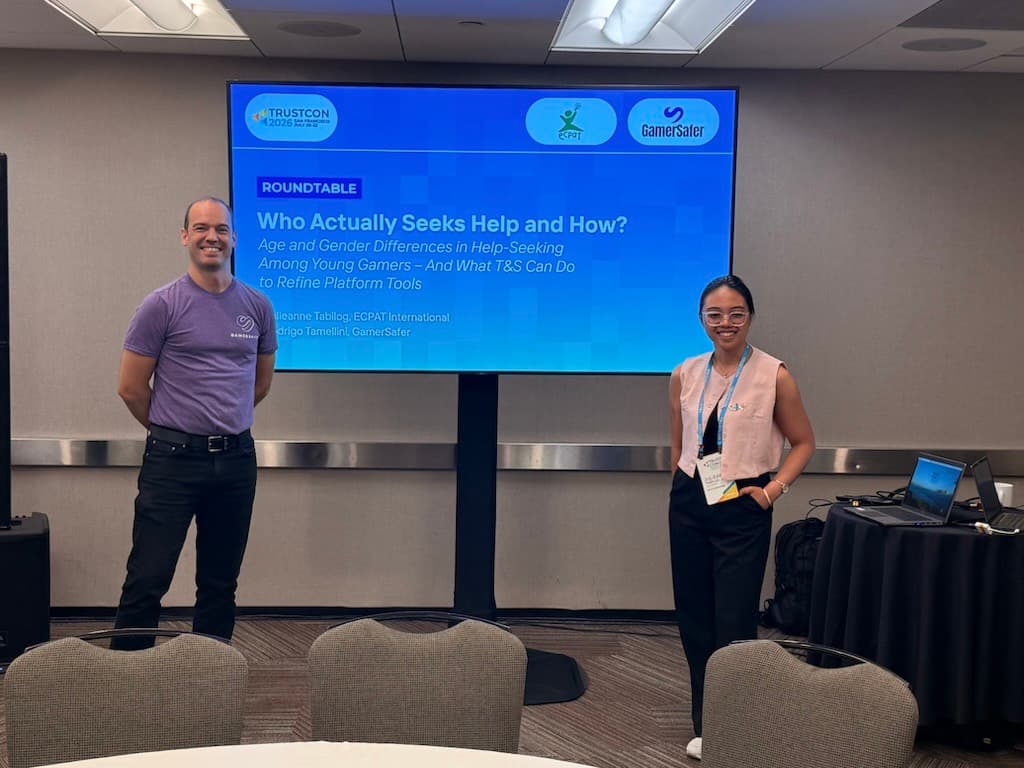
Last week at TrustCon in San Francisco, I spent 90 minutes in a room with about twenty people who build and run the safety systems that millions of young players depend on. Child safety leads, product managers, reporting system designers, policy professionals, researchers.
We were there to talk about something we had just published with ECPAT International: Designing Player Support That Works: Age and Gender Considerations in Platform and Community Safety, a data snapshot built on an in-game survey of 1,991 child and youth players in the Minehut community. It asks where young players actually go when something goes wrong, how that changes with age and gender, and how often they go nowhere at all.
I co-facilitated the roundtable with Julieanne Tabilog, Gender and Online Gaming Associate at ECPAT International and one of the report's authors.
A note on attribution: the session ran under the Chatham House Rule, so nothing here is attributed to any participant or company. What I can share is where the room went and what we are taking home.
Half the players we surveyed use AI for help… but nobody designed for that purpose
About half of the players we surveyed (49%) said they have used AI tools to get help, either with something in the game or with something in real life. Use peaks in mid-adolescence, at 56% among 15 to 17 year olds.
Most of it is practical. The single most common purpose was help with an in-game task or quest. But nearly one in five used AI for advice on a real-life problem, roughly one in eight used it to talk about how they were feeling, and a smaller group used it to learn about gender or identity.
Nobody in this industry designed that pathway. Nobody vetted which models young players are talking to, or built an escalation route for the moment an in-game question turns into something heavier. It arrived on its own, and it is already carrying weight.
A third of them ask no one at all
The other number that stopped us describes the players using no channel at all.
Roughly one in three (32%) said they usually do not ask for help with an in-game problem. For struggles outside the game, more than one in three (37%) said they do not reach out to anyone, on or off platform. Both numbers climb with age.
Younger teens lean on quick-access channels. In-game chat was the most common answer at 48%, followed by server staff. Those channels fall away as players get older, and the preference not to reach out becomes more common. Mid-adolescence, 15 to 17, looks like a distinct phase, with heavier reliance on peers and the highest AI use of any age group.
Where players go also depends on what went wrong. Only a small share, between 6% and 12% depending on the category, used the same type of support for in-game and out-of-game concerns. A player who will happily use in-game chat to ask about a broken build may have nowhere they trust for anything harder.
One caveat, because it is in the report and it shaped the conversation: this is an exploratory snapshot of one community at one point in time, not a statistically representative picture of gaming. Subgroup samples for girls, young women, and non-binary players are small, and those findings should be read as directional.
Of course, as helpful as this data is, the report alone will not solve these problems. It cannot tell a studio what that data means inside their own product, because every game is different. The social dynamics are different, and so is the set of tools each team has to reach players who are looking for help. So we put the findings in front of people who could translate them through their own operations, and asked what they would actually change.
Julieanne framed the same point from ECPAT's side:
"On its own, the research already had rich insights about young players' help-seeking behaviours. But in order to make practical recommendations, we needed to foster a space to talk about the implications together with the people from the industry who best know how and where change could start."
Most of the fixes turned out to be small
The goal was not to admire the problem. What stayed with me was how wide the range of realistic actions turned out to be, from structural to very simple. The ideas that stuck:
- Using player verification and identity signals to supplement what a team already knows about a player, so support can be calibrated to who is actually on the other side.
- Help-seeking prompts built directly into in-game broadcast and messaging systems.
- Community events that normalize asking for help, so it is not only a private, one-to-one action.
- Reporting flows designed for children specifically, not adult flows with the wording softened.
- Plain, accessible language at the exact moment a player is trying to ask for help.
The common thread is that most of this is shippable now, not a roadmap item for 2 years from now.
The industry already agrees on this
This is the part I did not expect.
The room converged. The findings landed as common sense, especially for the people sitting closest to player support. That is useful on its own. When practitioners with different products, different player bases, and different tooling all recognize the same pattern in their own funnels, it suggests the pattern is real and not an artifact of one community.
The more interesting thing is what did not happen. Julieanne named it directly:
"In other discussions, we sometimes expect a little bit of resistance, especially around things that seemingly introduce friction or over-cater to certain groups. Rather than diverging, the room actually agreed that there is high value in diversifying formats for safety, because young players and the way they engage with these tools vary greatly with age and gender."
She also pointed out how closely the room's own suggestions tracked what ECPAT already advocates for in its practical guide to gender-sensitive game safety and design: child-friendly reporting tools, accessible language, and positive community norms set as the default rather than the exception.
Not long ago, one flow for everyone was the default, and anything else needed a business case. In this room, nobody argued that a single safety format serves a 13-year-old and a 19-year-old equally well. The question had moved from whether to differentiate to how to do it without breaking the systems teams already run.
Where ECPAT goes next
The report closes with a list of open questions, including how help-seeking differs by gender across platforms, how in-game and Discord community formats compare, and the need for larger samples of girls and non-binary players. The roundtable sharpened where ECPAT wants to push first.
"Games now have much more diversity in their playerbase. Players carry different identities, motivations, and preferences in how they want to be supported. Given that online harms are evolving and the risks are greater for children and youth, this evidence is crucial for the people who design safety features, manage communities, and safeguard children in digital spaces."
ECPAT intends to build more evidence around gender differences in help-seeking across a wider range of games and online communities. We expect to be part of that work.
What changes on Minehut
For GamerSafer this is not academic. We operate Minehut, which is where this data came from, so we are both the researcher and the platform on the hook for acting on it. Three concrete things:
- Summarize the findings back to the community. That is transparency about the results. More than that, it is a bridge to a message that matters: ask for help when you need it.
- Build help-seeking messaging into our broadcast systems. The report argues for lightweight entry points rather than relying only on formal reporting flows. We already have the surface to do that.
- Tailor that messaging rather than sending one generic message to everyone. Age is the clearest lever the data gives us. The gender findings are directional given the sample, and we will treat them that way.
We plan to roll these out over time and measure the results.
This should not end at the conference
The full report is available here. If your team works on reporting flows, player support, or child safety and you want to compare notes on age-responsive design, reach out. The AI question in particular is not one any single platform is going to answer alone and we'd love to help.
Sources and resources
- TrustCon 2026: hosted by the Trust & Safety Professional Association, July 20 to 22, San Francisco.
- Designing Player Support That Works (ECPAT International and GamerSafer, 2026)
- ECPAT International: practical guide to gender-sensitive game safety and design
Thanks to the Trust & Safety Professional Association for the venue, to every participant who came ready to work, and especially to Julieanne Tabilog and ECPAT International, partners in this research and in the conviction behind it: safety systems should be built around the children who use them.