
Boys Are Learning Who They Can Be in Games. What Are We Teaching Them?
By Maria Tamellini, COO and Co-founder, GamerSafer
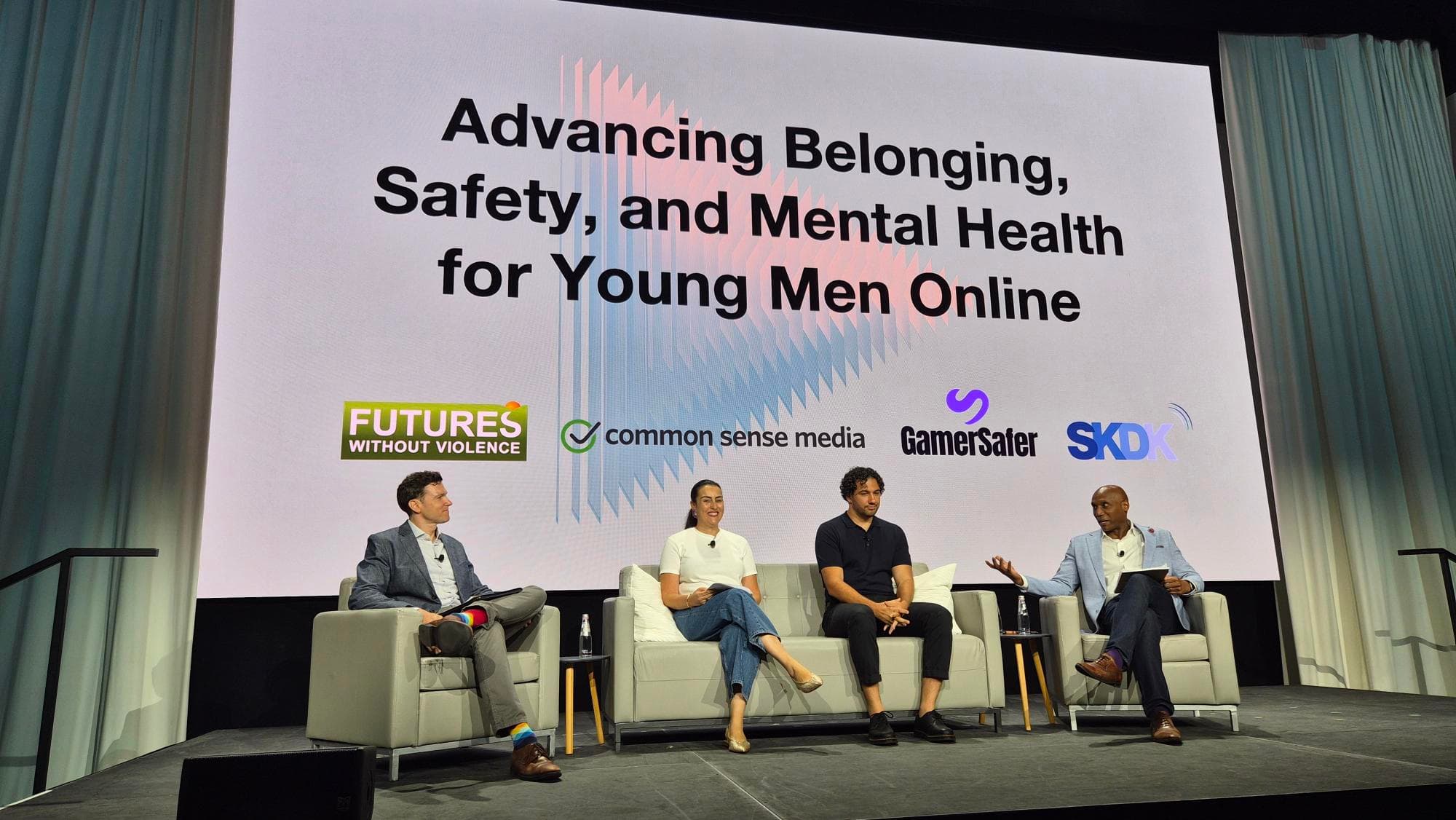
At Games for Change, I joined Michael Robb of Common Sense Media, Jesse Mahler of Futures Without Violence, and moderator Michael Frazier of SKDK for a conversation about belonging, safety, and mental health for young men online.
Research is giving us a clearer picture of the pressures shaping boys' lives online, from loneliness and emotional isolation to harmful gender norms and exposure to misogynistic content. The gaming industry now needs to ask what those findings mean for the environments we design and operate.
Games are not passive backdrops to these experiences. Games are fun spaces to be. They are also social systems where boys build relationships, explore identity, compete for recognition, and learn which behaviors earn acceptance or status.
Whether we intend to or not, gaming communities help shape how boys understand connection, vulnerability, respect, and masculinity.
What environments, spaces, and systems are we building for them, and what norms and behaviors are we reinforcing?
What research tells us about boys' online experiences
The research discussed during the panel points to a consistent tension in boys' digital lives.
Common Sense Media's Boys in the Digital Wild research surveyed more than 1,000 boys ages 11–17 in the United States. It found that 94% use social media or play online games daily. It also found that 73% regularly encounter content about masculinity, including messages related to money, muscles, dating, fighting, and weapons. Much of this content reaches boys without them deliberately searching for it.
Research from Futures Without Violence and Equimundo adds another layer. Nearly half of young men ages 18–23 said their online lives were more interesting than their offline lives, while two-thirds felt that no one really knew them. Their research describes a "crisis of connection" in which harmful voices often succeed because they offer young men recognition, certainty, and a community to join.
Online spaces can provide connection, identity, recognition, and community. At the same time, boys may also encounter pressure to perform toughness, suppress vulnerability, or conform to narrow expectations about masculinity.
The research also challenges the assumption that frequent online participation means boys feel supported. A young person can be highly active, socially connected, and still feel unseen or unsure where to turn when something is wrong.
What we are learning from boys who play Minecraft
GamerSafer is a Trust & Safety company that helps games build stronger systems for accountability and player protection. We also operate Minehut, a Minecraft server host, where we also apply those principles inside a live, youth-facing gaming community.
That gives us both research and direct operational experience.
Our recent report with ECPAT International, Designing Player Support That Works, is based on an anonymous in-game survey completed by 1,991 children and young adults on Minehut. Of those respondents, 1,480 identified as boys or young men. The study explored help-seeking behaviors, perceptions of community, and gender expression. The findings are exploratory and specific to the Minehut context, but they offer practical direction for the broader gaming industry.
Boys often seek help when it feels native to play (or where they are)
Among boys and young men seeking help with something happening in the game:
- 53% selected in-game chat;
- 28% selected server staff;
- 22% selected an in-game friend or group of friends.
These are immediate and familiar channels. In practice, boys may not begin by saying, "I am struggling." They are more likely to begin with a game issue, a conflict, something that feels unfair, or a question about what to do next.
That distinction matters for system design. A practical request can be the first step toward trust. But only if the people and tools around the player are prepared to recognize it, respond appropriately and escalate if needed.
Support therefore cannot live only in formal reporting flows, help centers, or external resource pages. Those channels remain essential, particularly for serious harms, but they need to connect with lower-friction entry points inside the player journey.
The report recommends testing approaches such as contextual prompts, chat-based commands, clearly visible staff presence, private or self-directed support options, and predictable escalation pathways.
Quiet isn't the same as okay
For personal struggles outside the game, 36% of boys and young men said they did not usually reach out to anyone. At the same time, 39% said they would talk with someone close to them in real life, and 32% would speak with a friend or someone they played with on Minehut.
The research does not tell us exactly why some players do not seek support. Possible explanations identified in the report include self-reliance, low perceived need, lack of trust in available channels or relationships, or other factors the survey did not capture.
But operationally, the finding challenges a common assumption: the absence of a report does not necessarily mean the absence of harm. Staying quiet about a challenge does not necessarily mean a player is okay.
A player can be active, social, and visible within a community while still feeling unable or unwilling to ask for help. This is why gaming companies need to go beyond merely offering a reporting tool. We need to understand whether a pathway feels credible, private when needed, age-appropriate, predictable, and socially safe to use.
Community culture impacts help-seeking
One of the most important findings was the relationship between community perception and help-seeking.
Players who described the Minehut community as welcoming, inclusive, or supportive were more likely to speak with someone they played with on the platform when facing a personal difficulty: 37%, compared with 29% among players who did not report that positive perception.
They were also more likely to approach a server owner or staff member: 12%, compared with 7%.
This is an association, not proof that positive community perception directly causes help-seeking. But it reinforces something we observe in practice: community culture is connected with a game support system.
Players are more likely to trust people and pathways when they believe the surrounding community is welcoming, fair, and responsive.
That makes community health more than an engagement outcome. It can influence whether a young person believes it is safe to speak. This is also the kind of investment that's hard to put a number on. You can't run a clean ROI calculation on "players feel more welcome." But the return shows up anyway: a safer community, players who feel able to stay and speak up, and players who feel welcome are players who come back. Community health isn't just a wellbeing metric. It's a retention stat too.
Boys learn what a community values by watching their peers
Our practitioner experience also reminds us that boys and young men are not one single audience.
They come to games for different reasons: competition, creativity, friendship, recognition, identity, status, and community. Their experiences also vary by age, social context, and the norms of the spaces they enter. But players quickly learn the unwritten rules of a community.
They notice:
- what earns status;
- what gets laughed at;
- what receives approval;
- when moderators intervene;
- who is protected;
- and what everyone allows to continue without challenge.
Peer culture can normalize humiliation, aggression, or emotional detachment. It can also reinforce empathy, cooperation, support, and care – and too often this is overlooked to focus only on the negative.
A player may find real friendship and recognition in a community while also experiencing pressure to perform toughness, avoid vulnerability, or remain silent when something is wrong.
These realities can coexist.
That is why participation is not the same as belonging. Engagement tells us that a player is present. It does not tell us whether he feels respected, able to express himself, confident in the response to harm, or safe enough to ask for help.
Taken together, the above research and experiences open an opportunity to our industry. It is not only whether a support resource exists. It is whether the full system around a player—product design, community norms, peer culture, moderation, recognition, and support pathways—helps him feel seen, understand what the community values, and trust it will support them through their different phases and challenges.
Why player mental health belongs in game and community design
Games make an enormous effort to understand their players: their motivations, preferences, identities, and what keeps them engaged.
Mental health should be part of that understanding, because designers and operators are building for young people who bring their emotional and social realities into the spaces they enter.
That does not mean games are responsible for causing or curing every mental health challenge. It also does not mean designers, community managers, or moderators should become therapists.
But games are important social environments. Young people spend time in them, form relationships, experience conflict, explore identity, and sometimes seek support.
Product and community decisions can either reduce or increase isolation, pressure, and barriers to asking for help.
Understanding player mental health therefore means designing communities that do not make difficult moments harder—and that can connect a player to suitable support and reliable resources when needed. That was also the framing behind my contribution to the panel.
At the end, games are leaders in creating online worlds where boys go and spend their time. What worlds are we creating?
Building healthier communities isn't just the right thing to do. It's also good for the bottom line. Research presented by Dr. Rachel Kowert at the Game Developers Conference this year, in her session The Toxicity Tax, examined players across six global gaming markets and found that half spend up to 60% less in toxic spaces or avoid games entirely because of a community's reputation. Toxicity does not just damage the player experience; it drives churn and erodes revenue. Trust and safety is not simply a cost center. It is a retention and long-term growth strategy.
A practical start for the gaming industry
The good news is that we don't need to solve every part of this challenge at once. A stronger starting point is to take practical steps, learn from players and experts in the field, and build from what works.
Build internal awareness: Who needs to know about this conversation?
One of the clearest lessons I've learned at Minehut is that responding to these challenges takes a village.
This cannot sit only with Trust & Safety or community teams. Product, design, research, policy, moderation, education, partnerships, and leadership all shape the systems boys experience.
In practice, I start by bringing the conversation into the team – whether that's internally at GamerSafer or externally with a customer or partner. I share research takeaways, raise the questions that are keeping me up at night, invite colleagues to review my notes before talks, and organize brainstorming sessions to test what may be viable.
I also invite partners and outside experts to speak with the team. That helps us challenge assumptions, understand what we may be missing, and connect our work with people who have deeper expertise in boys' mental health, healthy masculinity, child safety, and digital wellbeing.
Then I look for the people inside the organization who are ready to carry the work forward. Those internal champions matter. They help turn a broad concern into practical decisions, pilots, partnerships, and changes to the player experience.
The first step is not having every answer. It is making sure the right people are in the room, the evidence is being discussed, and someone is willing to move the work forward.
Involve boys in shaping the response
We should not assume we already know what boys need from games and gaming communities.
As the report Designing Player Support That Works shows, their experiences vary by age, identity, community, and the reasons they play. What feels supportive to a 13-year-old may not work for a 17-year-old. A pathway that looks clear to a product team may feel exposed, confusing, or socially risky to the player expected to use it.
That means boys should be involved in shaping the systems intended to support them.
Examples include: asking relevant questions in player surveys, test support pathways with young players, create youth advisory groups, invite feedback on community rules, and ask players what makes it easier or harder to seek help. Games remain accountable for the systems they operate. But listening to boys can help us avoid designing around assumptions and identify needs that may not be visible in traditional product or safety metrics.
Add signals that show how boys experience the community
Engagement and retention are essential indicators of whether players are finding value in a game.
But they may not fully show how boys experience the social environment around it, including whether they feel respected, supported, or able to participate without conforming to harmful expectations.
Teams can look for additional signals of trust, fairness, agency, and belonging—and then determine how those signals can be measured over time.
Do players understand the rules and what happens when they report a concern? Can they ask for help without losing status? Can they disagree or show vulnerability without becoming a target? Do they see staff and peers reinforcing healthy community norms?
These questions do not replace engagement metrics. They add context that can help teams understand the quality of the player experience and identify where community systems may need attention.
Apply what you learn across existing systems
What we learn from boys—and from the teams designing the player experience—should inform your systems.
Product, community, moderation, support, policy, research, and design teams can help interpret where those experiences connect to current systems, constraints, and opportunities.
At Minehut, some of the steps we have been discussing include:
- adding clearer examples of expected behavior to server guidelines, so players can see what respectful disagreement, de-escalation, and support for others look like in practice;
- reviewing onboarding and lobby experiences so younger players can quickly understand the rules, where to find help, and who they can trust;
- using community campaigns, staff messaging, and educational content to reinforce that asking for help is acceptable—and that supporting others can be a form of leadership;
- reviewing whether server culture, moderation practices, and recognition systems may be unintentionally rewarding aggression, humiliation, or emotional detachment;
- and continuing to ask players what makes support feel useful, confusing, exposed, or trustworthy.
From policy and game dynamics to moderation, community culture, support pathways, and player education, no single part can carry the full responsibility.
The goal is not to create a separate system only for boys. It is to use what boys and internal teams teach us to improve the systems already serving the full community, while recognizing that age, gender, identity, and social context can shape how those systems are experienced.
This is where listening becomes operational. Insight from players and teams can lead to clearer expectations, better tools, more consistent responses, stronger community norms, and changes players can actually notice.
Start simple, then build from what works
Smaller and simpler interventions can still make support for boys more visible and accessible.
Teams can begin by:
- making trusted resources easier to find;
- adding simple in-game or community prompts that point players toward help;
- including specific examples of expected behaviors to community guidelines, showing what "good" looks like, and finding ways to reward those behaviors;
- clarifying what moderators and support teams can—and cannot—do;
- partnering with organizations already working on boys' mental health, healthy masculinity, child safety, and digital wellbeing;
- training community teams to recognize when a practical question may signal a broader need;
- and reviewing whether onboarding, community spaces, and support pathways reflect the needs of different age groups.
Game and community design can also respond to critical needs boys consistently express: connection, recognition, competence, agency, and trusted relationships.
That means designing environments where players can find support, ask questions, recover from conflict, and connect with trusted people without unnecessary friction or stigma.
Where the industry goes next
Healthy communities are not separate from successful games.
When players feel respected, fairly treated, and confident someone will respond when it matters, that's also what builds lasting engagement, retention, and advocacy.
The conversation about young men online tends to focus on what's going wrong. That's fair. But it's not the whole story. Games already offer much of what boys are searching for: friendship, challenge, identity, recognition, community.
Games aren't going anywhere in their lives. The question is how intentional we're willing to be about the kind of belonging they build.
Sources and further reading
- ECPAT International & GamerSafer. (2026). Designing Player Support That Works: Age and Gender Considerations in Platform and Community Safety.
- Games for Change 2026 session: Advancing Belonging, Safety, and Mental Health for Young Men Online.
- Kowert, R. (2026). The Toxicity Tax. https://gdcvault.com/play/1036000/The-Toxicity-Tax-Why-the
- Kowert, R. (2025). Don't Tell Us What to Do (But Do Keep Us Safe). https://www.salgaming.com/news/understanding-the-needs-of-video-game-digital-communities
- Robb, M. B., & Mann, S. (2025). Boys in the Digital Wild: Online Culture, Identity, and Well-Being. Common Sense Media.
- Brito, P., Hayes, C., Lehrer, R., & Mahler, J., Salinas Groppo, J. (2024). The Manosphere, Rewired: Understanding Masculinities Online & Pathways for Healthy Connection. Washington, DC: Equimundo.